Thursday, April 14, 2011

American Gothic House Appears in Multiple Paintings

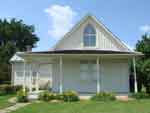
Grant Wood sketched the American Gothic House in 1930, and we all know the story that followed. The house is one of the most recognizable houses in America and is by far the most well-known of any house Wood painted. Still, it is one building among many in Wood’s large body of work. Birthplace of Herbert Hoover, Arbor Day, The Midnight Ride of Paul Revere, Stone City and Parson Weems' Fable all include architecture. But variations of the American Gothic House appear repeatedly, and not just throughout the numerous American Gothicparodies.

In 1931 Wood painted Appraisal, an artwork whose main characters are a chicken and two women from different backgrounds. Much has been said about this image—some have pointed out that the woman in the fur coat has a facial profile closely resembling the chicken’s, others have drawn conclusions about why the chicken has the fanciest coat of the three. I would like to direct your attention to the background, where Wood has placed a familiar front porch on a simple white house. Based on Wood’s sketch of the house (click the images to enlarge them), it’s hard to say what color the front screen door was when he visited Eldon in 1930. Older photographs of the house do show its door painted the same color as the one in Appraisal. Probably just a coincidence, but interesting nonetheless.

Nine years after he painted American Gothic and just three years before his death, Grant Wood again referred to the house in Eldon. Fertility, a lithograph, contains an almost exact recreation of the American Gothic House. The small home is painted white and has a simple front porch and a peaked roof with a Gothic window.

Wood’s 1942 painting Spring in Town depicts all the activities of preparation for warmer months. Tilling the garden, giving the winter blankets a wash, and trimming trees take place in the foreground. The shape of the central green house, based on an Iowa City home, echoes the shape of the American Gothic House. An even more striking similarity sits just beyond. Two men work hard in the yard of another little white house with a front porch.

Wood's style used repeating patterns, shapes, and objects. The brooch worn by his sister Nan in American Gothic and his mother Hattie inWoman with Plants actually belonged to his mother, a souvenir from Grant's travels. It follows that the American Gothic House, referenced again and again in his paintings, held some kind of important meaning for Wood.

The rural Anamosa home where the Wood children were born was destroyed by a fire in 1974. I was able to find one photograph of the house (not an online version, unfortunately), and sure enough, I saw a white home with a front porch. Although much larger than the house in Eldon, Wood's childhood home has a tall square window as the centerpiece in a peaked roof above the porch.

I don't like to assume I understand any artist's intentions. Maybe Wood was remembering his birthplace, maybe he was paying tribute to the house that helped launch his career, or maybe it was just a common style of building. Whatever the case, the little house in Eldon continues to prove its significance not only to Wood but to all who visit it, live in it and near it, and care for it.

Thursday, April 7, 2011

1142 E. Court Street

Grant Wood affectionately called his Iowa City home 1142, for its location at 1142 E. Court Street. Wood moved in to 1142 in 1935 and began teaching at the University of Iowa. During the next two years, Wood made the house his home by remodeling, just as he had in his studio at Turner Alley. He designed his own furniture, returned the building’s shutters to their proper place around the windows (He found them in the backyard, functioning collectively as a chicken coop.), and changed the landscaping. Wood’s studio, reminiscent of his Cedar Rapids days, was located in the carriage house.

Like the American Gothic House, 1142 is not open to the public. It has been preserved in a different way. Not stagnated by unchanging recreations of life from another time, not restricted by roped off doorways, not made stale with limited seasonal hours and a lack of human presence like many historic buildings. The house at 1142, like the American Gothic House, has continued to evolve and grow richer in its history over the years—because it’s being lived in.

The house has been occupied by lawyer and art collector James Hayes since he purchased it in 1975. Prior to buying 1142, Hayes rented the carriage house where Wood kept his studio. In 1978 the house was placed on the National Register of Historic Places, and author Richard King published a book detailing the building’s history in 2008.

This video from the archives of the Daily Iowan depicts the outside of 1142 and gives a little history of the house and its architecture.

If this beautiful historic house is privately owned, how can one get beyond the picket fence? It just so happens that this year’s American Gothic House Center bus trip includes a rare tour of 1142!

It’s not too late to sign up! Click here for information on the day’s itinerary, meals, and ticket prices.

Thursday, March 31, 2011

Kids enjoy a tour of AGHC!

Last week the American Gothic House Center gave tours to Eldon’s Living Hope Preschool. On Thursday morning, 18 three-year-olds quietly entered the building in two straight lines and sat down on the floor, anxious to learn about, well… pretty much anything. They were like little sponges, absorbing facts about Grant Wood, the American Gothic House, and the famous painting. With just a slight prompt throughout the morning, they would excitedly repeat these facts in answer to my questions.

After pointing out the painting’s repeated shapes (CIRCLES!! STRAIGHT LINES! DIAMONDS!!), establishing the characters (My dad is a farmer! My mom is a farmer, too!), and talking about how great it is that a famous artist like Grant Wood visited their town and made a painting of the house here, the kids patiently sat through an animated film. Then, they got to make their own art.

Given one or two crayons and a line drawing of the American Gothic House, the three-year-olds proceeded to color. Some were meticulously staying inside every line, holding crayons tightly between tiny fingers and pressing hard so the wax shone on the paper. Others took a more abstract approach, loosely scrawling across the page without concern for the house shape below. The artist in me couldn’t help but wonder how growing up exposed to an art icon such as the American Gothic House will affect these mini-humans. With teachers like those at Living Hope, prompting the kids to come back with their families and getting excited along with their students, I expect at least a few artists in the bunch.

Some interesting articles came up this week and last about kids and their artistic pursuits. A story in the Daily Nonpareil Online describes students in Council Bluffs, home of a Wood mural, studying Grant Wood. An exhibition spotlighting children’s art in Mason City, as reported by the Globe Gazette, featured a parody of American Gothic. Ever heard anyone describe an abstract painting with the phrase “My child could have done this.”? Take a look at this study comparing children’s art to the art of famous abstract painters—the results may surprise you!

Grant Wood was an artist from early childhood, and his sister Nan was, too. As you’ll find out when you visit our new exhibit, Nan Wood Graham: Beyond the Farmer’s Daughter, when Nan was a girl she won an art contest and received a small cook stove for a prize. Young Nan's classic childlike enthusiasm caused her to faint from the thrill of winning! I'd bet that she and Grant would be equally thrilled at the enthusiasm kids today are showing for American Gothic.

I hope to see you tomorrow night (6-7pm) at the exhibit premier!

Molly Moser
Administrator

American Gothic House Center
theamericangothichouse@gmail.com

Only a couple of weeks left to sign up for the American Gothic House Center’s annual bus trip to discover Grant Wood country! You can view a detailed itinerary of the trip on our website. The itinerary has links to all the collections we’ll be visiting. Call me at 641.652.3352, or respond to this email to e collections we’ll be visiting. Call me at 641.652.3352, or respond to this email to reserve your seat!

The American Gothic House Center strives to become financially independent through gift shop revenue, sponsorships, and by establishing an endowment fund. Funds raised in this campaign will be used to match the Iowa Cultural Trust Endowment Challenge Grant and will become endowment funds to support the Center's annual operations. As a subscriber to the weekly newsletter, you have already shown support for the American Gothic House Center. I invite you to strengthen your role in the valuable experience we provide the community by making a contribution to our fund drive. Click here to give your tax deductible gift, or head to our website for more information. Thank you to all who have donated so far!

Thursday, March 24, 2011

Exhibit Opening!

Good morning! I’m happy to report last Saturday’s spring sale and art & poetry exhibition inside the American Gothic House carried our visitor count over 100 for the day. That is our highest daily attendance so far this year--a great jump start to the new season!

Our next event is the opening of this year’s exhibit, Nan Wood Graham: Beyond the Farmer’s Daughter. The exhibition brings deserved focus to the life of American Gothic’s female model, Grant Wood’s sister and fellow artist Nan Wood Graham. The new display features an interactive audio component and Nan Wood Graham’s only original oil painting, on loan from the State Historical Society of Iowa.

Nan was a loyal advocate for her brother Grant, protecting his public image after his death by screening his would-be biographers, attending art openings in his honor, and keeping a watchful eye on the multitude of American Gothic parodies. She eventually wrote and published a biography of her brother titled My Brother, Grant Wood. Nan’s insights into the childhood and artistic process of Iowa’s beloved artist provide a unique look at the artist—closer than we can normally come when studying art history.

Though Nan Wood Graham is most well-known for her role in American Gothic , she led a full and exciting life of her own. Nan’s aunt once told her, “One artist in the family is enough.” Nan did not pursue a career as an artist, but continued to study art and practice creative hobbies. While recovering from tuberculosis in Oakdale Sanitarium, Nan learned leather tooling and later won prizes for her talents. Grant even invited her to teach at his artist colony in Stone City. Nan mastered the difficult technique of reverse painting on glass, and her glass paintings were exhibited in New York. She made one oil painting, Boarding House Bath. The painting was likely inspired by the astounding characters Nan and her husband Ed lived with in various rooming houses around California.

Nan’s personality and delightful sense of humor shine brilliantly in an audio interview from the 1970s. Clips of this interview are available at the touch of a button in new exhibit. While reading through exhibit text, visitors will find reference to audio clips where they can listen to Nan tell more about the topic.

Nan Wood Graham visited Eldon on several occasions and was an honored guest at the city’s annual Gothic Days celebration. Many locals met Nan during her lifetime, exchanged letters and gifts, and have photographs of her in their personal albums. A few of these items, as well as correspondence with Nan, will be on display.

I invite you to join us for the premier of this interactive new exhibit! Enjoy refreshments and conversation with other Wood enthusiasts at the opening on Friday, April 1 from 6-7 pm. Hope to see you there!

Molly Moser
Administrator
American Gothic House Center
theamericangothichouse@gmail.com

Don’t forget to sign up for the American Gothic House Center’s annual bus trip to discover Grant Wood country! You can view a detailed itinerary of the trip on our website. The itinerary has links to all the collections we’ll be visiting. Call me at 641.652.3352, or respond to this email to e collections we’ll be visiting. Call me at 641.652.3352, or respond to this email to reserve your seat!

The American Gothic House Center strives to become financially independent through gift shop revenue, sponsorships, and by establishing an endowment fund. Funds raised in this campaign will be used to match the Iowa Cultural Trust Endowment Challenge Grant and will become endowment funds to support the Center's annual operations. As a subscriber to the weekly newsletter, you have already shown support for the American Gothic House Center. I invite you to strengthen your role in the valuable experience we provide the community by making a contribution to our fund drive. Click here to give your tax deductible gift, or head to our website for more information.

Thursday, March 17, 2011

An Eldon Artist?

As I continue researching connections between Grant Wood and today’s artists, I come across more and more notable artists with ties specifically to southeast Iowa and Eldon. A few weeks ago one community member brought to my attention a painter named John Mulvany.

John Mulvany was born in Ireland in the1840s and moved to the US with his family during the following decade. His history is not well documented (most sources even disagree about his birth year, which doesn’t bode well for information about the life that followed), so I’ve pieced together what I can from correspondence, newspaper clippings, and online resources.

Mulvany studied at the Academy of Munich and returned to the US to begin his career as an artist. He progressed to painting what was considered the highest level of subject matter, historical group portraiture. Mulvany traveled and lived around the Midwest. Much of his work depicted scenes from the Civil War and from Irish history. Mulvany’s most famous painting is Custer’s Last Rally, completed in 1981 at an astonishing size—11 x 20 feet! In order to accurately depict the scene, the artist spent two years painting and researching at the battlefield and on Souix reservations. See a lithograph of the painting here (click on the image to enlarge it for a better view).

John Mulvany’s ancestors, also originally from Ireland, kept a saloon in Eldon until the Temperance Movement. Some family members lived in Ottumwa. His painting titled Trial of a Horse Thief is of particular interest to those living in our area. The preliminary painting is owned by the Szymanski Gallery in Pasadena, California. A booklet describing the piece was printed by the gallery in 1978 and named each of the characters in the painting. Mulvany did not make up this dramatic scene—he painted a specific trial at a specific location, including portraits of key personalities. According to the gallery, the trial took place in Kansas.

Despite the gallery’s confidence in naming the characters in the artwork, the Kansas State Historical Society is unable to verify the information in the booklet. Correspondence in 1987 between AGHC contributor Helen Glasson and Anne Weber-Scobie, a descendant of John Mulvany, suggests the trial may have taken place in Iowa. Mulvany's connections here, maybe the trial even took place in Eldon! (Take a second look at the painting—recognize anyone you know?) Weber-Scobie is an artist with an interest in family history. And why not, with relatives like the successful John Mulvany?

I hope to see you this weekend at the American Gothic House Center’s spring sale (most items 10% off, some up to 50% off!) and at the art and poetry exhibition inside the American Gothic House!

Molly Moser
Administrator
American Gothic House Center
theamericangothichouse@gmail.com

Don’t forget to sign up for the American Gothic House Center’s annual bus trip to discover Grant Wood country! You can view a detailed itinerary of the trip on our website. The itinerary has links to all the collections we’ll be visiting. Call me at 641.652.3352, or respond to this email to e collections we’ll be visiting. Call me at 641.652.3352, or respond to this email to reserve your seat!

The American Gothic House Center strives to become financially independent through gift shop revenue, sponsorships, and by establishing an endowment fund. Funds raised in this campaign will be used to match the Iowa Cultural Trust Endowment Challenge Grant and will become endowment funds to support the Center's annual operations. As a subscriber to the weekly newsletter, you have already shown support for the American Gothic House Center. I invite you to strengthen your role in the valuable experience we provide the community by making a contribution to our fund drive. Click here to give your tax deductible gift, or head to our website for more information.

Thursday, March 10, 2011

Spring, is that you?

Visitor numbers are on the rise again, and it appears that the cold may finally be loosening its grip on us! I’d like to recap the big events that took place in the quiet months of winter and remind you of what spring has in store for the American Gothic House Center.

With the help of many wonderful volunteers, we were able to make some cosmetic and organizational improvements at the Center. We’ve been taking inventory of our collection. We'll be able to use our objects more effectively by rotating what's exhibited in our display cases. This process consists of photographing, numbering and organizing all the objects in our collection, and entering information about each into a database.

Matching hangers have unified the appearance of our costume rack, and a new panel above the rack shows visitors how to set up their own parody photo. A grant from the Central Iowa Tourism Region helped fund this new panel. Check it out on facebook!

We are grateful to the Wapello County Foundation for a grant which will provide us with a point-of-sale system for the gift shop, simplifying check out for volunteers and customers. The new system will make reporting about gift shop inventory and sales much simpler and will be synchronized with our soon-to-be launched online shop.

As you know from last week’s newsletter, we also received a grant from the Iowa Cultural Trust to begin establishing an endowment fund for the Center. Funds raised in this campaign will be used to match the Iowa Cultural Trust Endowment Challenge Grant and will become endowment funds to support the Center's annual operations. There is a link to donate below for your convenience. (It works this time, I promise.)

This winter, the American Gothic House Center hosted several successful events. In December we had a gingerbread house decorating activity for area kids. We also participated in the Tour of Homes, a traditional event in Eldon in which several homes and businesses are chosen to be decorated and open for tours. Last month we had our annual Grant Wood Birthday Soup Smorgasboard, which fed about 75 people. Thank you again to all who help make our events a success!

The next event on our calendar is the spring cleaning sale on Saturday, March 19. All non-consignment items will be 10% off, with select items up to 50% off. Don’t miss the great deals that only come around once a year!

Those who visit between 1 and 5 on the 19th are invited to attend an art exhibition inside the American Gothic House. Priscilla Coffman, a motivated volunteer and board member, will have poetry on view on the second floor of the house. When I'm not writing newsletters or weeding the Center's flowerbeds, I am using a paintbrush. Lots of my artwork will be hanging in the house on the 19th. All are welcome to join us for the sale and exhibition that day!

Other upcoming events include our new exhibit opening at the Center on April 1 (More news about this very exciting exhibit will come next week!) and our annual bus trip on April 16. And it’s not too soon to start thinking about Gothic Days in June! Get sign-up information for our5K, bike ride, and art contest on our website!

Molly Moser
Administrator
American Gothic House Center
theamericangothichouse@gmail.com

Don’t forget to sign up for the American Gothic House Center’s annual bus trip to discover Grant Wood country! You can view a detailed itinerary of the trip on our website. The itinerary has links to all the collections we’ll be visiting. Call me at 641.652.3352, or respond to this email to e collections we’ll be visiting. Call me at 641.652.3352, or respond to this email to reserve your seat!

The American Gothic House Center strives to become financially independent through gift shop revenue, sponsorships, and by establishing an endowment fund. Funds raised in this campaign will be used to match the Iowa Cultural Trust Endowment Challenge Grant and will become endowment funds to support the Center's annual operations. As a subscriber to the weekly newsletter, you have already shown support for the American Gothic House Center. I invite you to strengthen your role in the valuable experience we provide the community by making a contribution to our fund drive. Click here to give your tax deductible gift, or head to our website for more information.

Thursday, March 3, 2011

Help us reach our goal!

Dear Readers,

Each week, I enjoy learning about Grant Wood and passing my discoveries on to you. I have received many personal responses to these weekly updates over the past few months, and I appreciate the investment of your time and energy in reading my messages and replying. Many of you are Eldon residents who support and volunteer at the Center. Some readers are past visitors, Grant Wood enthusiasts, or those who simply take an interest in art, history, and the world around them.

The American Gothic House Center is a permanent resource for art and cultural education. Our mission is to integrate the puzzle pieces of American Gothic by linking the house that inspired the painting to the impact of American Gothic and Grant Wood on American art. Those of you following this newsletter have seen the far-reaching effects of Wood, from teaching popular artist Isabel Bloom to leading a movement which gave us great American artists like Andrew Wyeth and Norman Rockwell.

Over the past three years, the American Gothic House Center has attracted travelers and educational institutions from Iowa and Missouri. In all, the Center has hosted nearly 35,000 people from all 50 states and 41 foreign countries. Annual visitor numbers are steadily rising, showing that our mission envelops a treasured part of history. The Center organizes bus tours, lectures, children’s events and school tours, teaching appreciation of precious Midwest cultural heritage to a variety of audiences.

The American Gothic House Center strives to become financially independent through gift shop revenue, sponsorships, and by establishing an endowment fund. We are the grateful recipient of an Iowa Cultural Trust Endowment Challenge Grant, which will match funds we raise to help start an endowment. As a subscriber to the weekly newsletter, you have already shown support for the American Gothic House Center. I invite you to strengthen your role in the valuable experience we provide the community by making a contribution to our fund drive. If you would like, you can use the donate button on our website to give your tax deductible gift.

The endowment campaign is the beginning of an ongoing drive to ensure the long term sustainability of the American Gothic House Center. Funds raised in this campaign will be used to match the Iowa Cultural Trust Endowment Challenge Grant and will become endowment funds to support the Center's annual operations. An endowment is a permanent, persistent resource which provides funding to expand during successful years and offers security in challenging times. Establishing an endowment to assist with operating expenses is the responsibility of any responsible nonprofit organization. With your support the American Gothic House Center can continue to attract visitors and provide education for many years to come!

Thank you for helping us reach our goal.

Molly Moser
Administrator
American Gothic House Center
theamericangothichouse@gmail.com

Don’t forget to sign up for the American Gothic House Center’s annual bus trip to discover Grant Wood country! You can view a detailed itinerary of the trip on our website. The itinerary has links to all the collections we’ll be visiting. Call me at 641.652.3352, or respond to this email to reserve your seat!

Thursday, February 17, 2011

Grant Wood's Main Street

Thank you to all the soup cooks, cake bakers, door prize donors, event workers and American Gothic House Center supporters who contributed to the success of Grant Wood’s Birthday Soup Smorgasboard! We fed about 75 and all donated generously. Your support is greatly appreciated!

I have often felt the loyalty and commitment of the surrounding community to the American Gothic House Center. It extends throughout the City of Eldon, whose residents are working to restore many historic landmarks and better their community by lending a hand whenever it’s needed. There is a certain wonderful quality in small towns; you receive smiles from strangers who know your face, and the mayor helps her city crew shovel the sidewalks of main street.

In 1920, a book called Main Street was published by Lakeside Press. Sinclair Lewis told the story of the characters of Gopher Prairie, a small town in Minnesota. The main character moves to Gopher Prairie from a large city and adjusts to life there. Grant Wood illustrated the book with nine full-page drawings done from 1935 – 1937. Two of the drawings depicted locations, and seven described character figures.

The seven character sketches, a group of four men and three women, summarized and satirized some of the personalities from the story. All but one are classic waist-up portraits, with titles to clarify the carefully drawn expressions on each face.

There is The Good Influence, a primly smiling woman dressed in a black collared dress and hat. She stands in front of a church, removing one black glove to expose a simple gold band around the third finger of her left hand. The Perfectionist regards the viewer from the sides of her eyes, hand on chin, thoughtfully sizing us up and deciding how to fix us. The third woman, the Practical Idealist, is captured mid-sentence—no doubt animatedly conversing about her latest project. She wears a sensible white button-up blouse with a black sweater, and is seated in front of subtle yet stylish floral wallpaper.

In General Practioner, Wood shows the gentle hands of a doctor checking his patient’s pulse. The worn blue quilt covering the patient tells us the local doctor is making a house call. Booster, a man in a yellow pin-striped suit and tie, waves his finger from behind a podium. His moose pin and stamped gold ring certainly declare his allegiance to important organizations. Behind him, an American flag stands as a reminder that this character could be found in any small town’s meeting room.

Another character in a yellow suit, this one with a bowtie, sniffs an elegant flower while staring toward the sky over the gold rims of his round glasses. He is the Sentimental Yearner, visions of yester-year visible behind his eyes. The last face is the face of The Radical. He glares suspiciously from beneath a corduroy cap. The ends of his moustache curl up mischievously, and he keeps a firm grip on the wooden handled tool he holds. Behind him are hammers, saws, and rulers—perhaps the tools of an artist?

The drawings were done on brown paper in pencil, charcoal, crayon and gouache (similar to watercolor). Grant Wood signed each of the 1500 books in the original print run.

Molly Moser
Administrator
American Gothic House Center
theamericangothichouse@gmail.com

Don’t forget to sign up for the American Gothic House Center’s annual bus trip to discover Grant Wood country! You can view a detailed itinerary of the trip on our website. The itinerary has links to all the collections we’ll be visiting. Call me at 641.652.3352, or respond to this email to reserve your seat!

Thursday, February 10, 2011

February: Not just for celebrating love!

Here comes February 14! Before you stop reading because you think this is yet another Valentine’s Day spiel, let me explain why I’m mentioning the date. Twenty years ago, on the 14th day of February, the American Gothic House was donated to the State Historical Society of Iowa.

The house had belonged to the Smith family since 1942. The Smiths purchased it from a family named Howard—interesting, as current tenant Beth Howard was born just a few miles away in Ottumwa.

Carl E. Smith donated the house. He must have been a romantic. Who wouldn’t appreciate the gift of a historic landmark on the traditional day of love? The State Historical Society quickly began renovations on the house to preserve its 1930s appearance, and the rest is history!

The planets must be aligned in some fancy cosmic way, because this year also marks the 130th birthday of the American Gothic House and the 120th anniversary of Grant Wood’s birth.

This Saturday, February 12, join the American Gothic House Center as we celebrate all these important dates. Enjoy delicious home-cooked soup with a side of fresh bread and crisp veggies. Soups straight from Eldon’s finest kitchens will include split pea, chili, chicken veggie, chicken with wild rice, broccoli cheese, potato and vegetable beef. Complete the meal and the celebration with a slice of birthday cake or a brownie and a mug of hot coffee.

Freewill donations are welcome. The event takes place from 11 am – 1 pm at the Eldon KD Center. Hope to see you there!

Molly Moser
Administrator
American Gothic House Center
theamericangothichouse@gmail.com

Don’t forget to sign up for the American Gothic House Center’s annual bus trip to discover Grant Wood country! You can view a detailed itinerary of the trip on our website. The itinerary has links to all the collections we’ll be visiting. Call me at 641.652.3352, or respond to this email to reserve your seat!

Thursday, February 3, 2011

Escape February with Hot Soup!

Good afternoon! Are you still there, beneath all this snow? I hope you’re reading from under a cozy blanket with a steaming mug of coffee in your hands. Or a bowl of hot homemade soup, or even a slice of warm birthday cake—Hey, you can find all that at the Grant Wood Birthday Soup Smorgasboard!

Next Saturday, February 12, join the American Gothic House Center as we celebrate the 120th anniversary of Grant Wood’s birth. Enjoy delicious home-cooked soup with a side of fresh bread and crisp veggies. Soups straight from the kitchens of delightful AGHC volunteers will include chili, chicken veggie, chicken with wild rice, broccoli cheese, potato and vegetable beef. Complete the meal and the celebration with a slice of birthday cake or a brownie and a mug of hot coffee.

Bring a friend or find one in a room full of company! Freewill donations are welcome. The event will happen over lunch, from 11 am – 1 pm at the Eldon KD Center.

The view from my window is brilliantly white, because the sun is shining! The driveway is plowed and sidewalks snow-blown (thank you to everyone who helped with that), giving visitors a clear path to our front door. Our feathered friends can now hop around on the thick layer of snow and peck at aster seeds, whose long stems are suddenly beak-height. There’s a bird today I haven’t seen before, with charcoal feathers and a white belly. He was a little camera-shy, but I did get a few photos.

Wintery as it is, birds and seeds make me dream of spring. This spring brings a new set of exciting stops on our annual tour of Grant Wood Country!

On Saturday, April 16, you can climb aboard a charter bus and travel with us to Davenport and Iowa City. The Figge Art Museum is our first stop. We’ll look at Regionalist artwork and a railroad photography exhibit. Next, we tour the University of Iowa Museum of Art in Iowa City, home of Grant Wood’s painting Plaid Sweater.

Grant Wood lived in Iowa City from 1935-1942. His home at 1142 E. Court Street is now owned and occupied by James Hayes, who has generously agreed to give us a guided tour. Don’t miss this rare opportunity to visit the beautiful house!

We’ll finish out the entertaining day with a buffet-style meal before heading home. You can view a detailed itinerary on our website. The itinerary has links to all the collections we’ll be visiting. Call me at 641.652.3352, or respond to this email to sign up!

Thursday, January 27, 2011

On the Web: Eldon Artist George Shane

Last week we learned about Ottumwa artists who studied with Grant Wood at the Stone City Art Colony. I received many responses from readers, and one introduced me to an artist from Eldon.

George Walker Shane was born in Eldon in 1906. As a journalist for the Des Moines Register, Shane often wrote about art. His combined interests in art and writing allowed him to travel to Venice and Mexico, sending articles back to be printed in the Register.

Shane was an involved member of the arts community in Des Moines. In 1951, Shane had a solo exhibition at the Des Moines Art Center. This activity and his career as a journalist introduced him to some very famous artists, including Alexander Calder, Andy Warhol and Salvador Dali, pictured with Shane on a visit to Iowa in 1952.

As with many of the artists we’ve covered, George Shane’s paintings were realistic and featured his immediate surroundings. He was interested in small town Iowa, depicting scenes of town squares and courthouses. Century farms were his main focus, and these paintings were very popular with Iowans. Again he was able to combine his interests in writing and art by researching the histories of the farms he painted. His series on hundred-year-old farms was printed in the Sunday Register, each painting accompanied by an historical article.

Thank you to the reader who alerted me to George Shane’s work. Keep the comments coming!

Thursday, January 20, 2011

On the Web: Ottumwa Artists at Stone City

With the recent re-launch of Mount Mercy University’s Stone City Art Colony research website (what a great resource!), I’ve discovered additional interesting students who studied under Grant Wood at the colony. Today I focused on Ottumwa artists, so many may recognize their names.

Newton W. Roberts (1881-1974)
Newton Roberts was a lawyer-turned-painter. One day, while his daughter and wife were away, he picked up his daughter’s paint brush and began to experiment. Without formal training, his connections with other Ottumwa artists lead him to the Stone City Art Colony. Clicking on the above link will give you an impressive list of his artistic successes, as well as several images of Roberts and his work.

Marion Gilmore Hulse (1909-1984)
Marion Gilmore, who later went by Mion Hulse, became quite an accomplished artist. Her mural Band Concert, done for the Corning, Iowa Post Office, shows cheerful children playing and friends chatting. There is a true Regionalist feel to this work, which realistically depicts Corning’s square and adds a certain optimistic glow to the event.

Other work by Hulse is very different stylistically, but still focuses on human interaction. Examples can be viewed below her brief biography.

Joseph Townsend Funk (1901-1985)
Joseph Funk was employed by Ottumwa’s Union Bank and Trust. He hosted Edward Rowan while the Little Gallery’s satellite was in Eldon. He began as a painter, but eventually gravitated toward industrial design and color engineering. Those interests lead him to help companies select colors for products and make decisions about the structural elements of buildings. Funk helped design the Ottumwa Armory-Coliseum and launch the Ottumwa Community Art Center.

Bertha Graves Morey (1882-1962)
Like many devoted natives of Southeast Iowa, Bertha Morey was a talented multi-tasker. Her interests were broad, including landscape painting, photography, silk, jewelry and bookplate design. She was curator for a traveling watercolor exhibit in Ottumwa and operated her family’s clay company after the death of her father and brother. The Morey Clay Products Company produced roughly seven million paving bricks each year. Morey’s father was also an artist of sorts, designing and building one of the world’s largest continuous kilns.

Bernard LaMarr Ferguson (1911-1977)
Bernard Ferguson assisted with the opening of five Iowa art institutes, and possibly the Davenport Municipal Art Gallery. He was chosen for Carnegie-sponsored training with Hungarian painter Jaroslav Brozik. During this time he met Johh Sharp and others he would study with at the Stone City colony.

Grant Wood had a lasting impact on Southeast Iowa. Sure, he immortalized a simple piece of architecture in 1930. The painting enhanced Iowa’s image and reputation across the nation, and has quite an economic impact each time it travels to its home state. The American Gothic House Center, which of course wouldn’t exist without the painting, brings 10,000 people through Eldon annually. Grant Wood’s brush with Eldon is still affecting our daily lives 81 years later.

Wood’s presence in this portion of the state extends beyond American Gothic. He is alive in stories told by locals who remember seeing him doodling on the street or speaking with him. Many have personal relationships with his sister Nan, model for the iconic painting. His legacy is carried on by all the artists he taught, and those they taught, and so on. Lucky are we to have so many from Wapello County who studied with him at the Stone City Art Colony.

Thursday, January 13, 2011

Winter in Wapello

During the lovely hot, humid days of summer I often ask myself, “How did I ever make it through winter?” I shudder at the thought of facing the next one—closed indoors, muscles clenched against the wind, not able to take a deep breath because the air is so painfully bitter. What I forget during the green season is the magical sparkle of a snow-covered world. Those mornings when frost forms inside my nostrils are the very same mornings that leave every stem, leaf and hillside stark white and glittering.

Who am I to complain about cold, anyway? The bare-footed chickadees feasting on dried aster seeds outside my window at the American Gothic House Center are bravely facing January. Click for photos of them!

We very often see Grant Wood’s sunny Iowa landscapes, but at this time of year it’s easier to appreciate several winter scenes he produced.

December Afternoon
January
February

Don’t let the frigid air slow you down! It’s toasty and warm inside the American Gothic House Center, and we’re still open 7 days a week. Stop by anytime to thaw out and learn more about Grant Wood and the house next door.

While you’re out and about, take the time to visit local artist Chris Abigt’s show, Uncommon Commonplace, at the Indian Hills Art Gallery in Ottumwa. Uncommon Commonplace is on view in the gallery until Thursday, February 20. Chris is the resident artist at MJ Art Gallery in Ottumwa. You may also recognize her name from the Center’s gift shop, where we are proud to sell prints and note cards of her painting Gothic Windows.

Keep warm—but enjoy the cold!

Thursday, January 6, 2011

Wood's Influence, Continued

Last Thursday’s exploration of the environment surrounding Wood and the Regionalists provided many answers, but in the end my brief research lead to more questions. Continuing forward in history, today I investigated two American artists whose work shows ties to the ideas and subject matter of Regionalism.

On Sunday, the Smithsonian American Art Museum closed its exhibit "Telling Stories: Norman Rockwell From the Collections of George Lucas and Steven Spielberg." The exhibit featured 57 works by Rockwell and drew over 700,000 viewers during the six months it was on view.

Like Grant Wood, Rockwell cherished childhood summers in the country and drew on these memories for later paintings. He began drawing as a young boy and left high school in 1909 to pursue art at the National Academy of Design. At only 22, the illustrator was published on the cover of the Saturday Evening Post. The Post continued to feature his illustrations for four decades. Once again recalling Wood, Rockwell painted murals and his artistic talent served his country as a military artist during WWI.

Widely popular (so I won’t get into too much description), Rockwell is known for his cheerful depictions of small-town American life. In the 1960s he began to illustrate for Look Magazine, where his drawings became both more personal and political. During the ten years he worked for Look, his subject matter included civil rights, poverty, and space travel.

The idealized, loyal illustrations of Norman Rockwell undeniably resemble the patriotic themes of Regionalism. Steven Spielberg said of his Rockwell collection, "I look back at these paintings as America the way it could have been, the way someday it may again be." To me, his statement sounds like a way to describe the work of Grant Wood.

Another popular illustrator working during the time of Norman Rockwell was N.C. Wyeth. The Wyeths were a family of artists, and N.C. had a son Andrew who became famous for his paintings. Andrew Wyeth, sometimes called “Painter of the People,” worked in a regionalist style until his death in 2009. Wyeth is most famous for his painting “Christina’s World,” a portrait of his disabled neighbor crawling through a field because she chose not to use a wheelchair.

Like the Regionalists, Wyeth championed America and scorned Modernism. Wyeth “was also a vocal patriot, which… dovetailed with a general sense that his art evoked a mythic rural past embedded in the American psyche,” wrote Michael Kimmelman for the NY Times.

Wyeth painted his family and friends as well as the Pennsylvania and Maine landscapes that surrounded him. When the bohemian artist lifestyle became trendy, Wyeth rebelled by exhibiting the more traditional behavior of the Regionalists. A 1963 journalist described his work: “In today’s scrambled-egg school of art, Wyeth stands out as a wild-eyed radical. For the people he paints wear their noses in the usual place, and the weathered barns and bare-limbed trees in his starkly simple landscapes are more real than reality.”

In explaining the meaning behind his work, Wyeth also describes the beautifully mysterious qualities in many Regionalist landscapes and portraits. “Let’s be sensible about this. I put a lot of things into my work which are very personal to me. So how can the public feel these things? I think most people get to my work through the back door. They’re attracted by the realism and they sense the emotion and the abstraction — and eventually, I hope, they get their own powerful emotion.”

Thursday, December 30, 2010

Grant Wood in an Art Historical Context

My first few weeks at the American Gothic House Center were spent rapidly absorbing facts about Grant Wood’s life and artwork: The timeline of his birth, travels, and artistic career; his influential and well known works; and his jobs as teacher, designer and professor. I learned all about Wood’s internal motivations for pioneering Regionalism, like his Iowa farm roots and a style-altering trip to Germany.

I am a big picture person, and I always want to know why. Very quickly I began to rifle through my memories of an American art history class I took at the UI. What was on the world news during the late 1920s and 1930s? Who were the other standout painters of the time period, and what relationship did Wood’s work have to those artists?

Between World Wars I and II, “Regionalist artists reflected the isolationist attitudes of the country.” The UIMA, in its description of “Plaid Sweater,”goes on to describe the art created during this time as socially conscious but exceedingly patriotic in its portrayal of American life and land. Themes like agriculture and small-town America, emphasized by the WPA, were meant to empower Americans suffering through the Great Depression.

Outside this small bubble of Regionalism consisting of Wood, Thomas Hart Benton and John Stewart Curry was Modernism. The Modernist movement included well known artists like Henri Matisse, Pablo Picasso, Juan Miro and Jackson Pollock. Modernists were interested in human values and concerns, and have been described as global thinkers. Regionalists promoted America and viewed Modern art as elitist and foreign.

It’s easy to see the contrast between the two movements, but is there a comparison?

Jackson Pollock is a particularly interesting connection between Regionalism and Modernism. Pollock studied Regionalism with Thomas Hart Benton for three years, learning its philosophy of authentic American realism. However, by the early 1940s his work had become completely abstract. He abandoned the use of brushes and dripped paint onto a canvas placed on the floor. Benton’s student made so complete a transformation that he spurred a new great movement within Modernism—Abstract Expressionism.

Pollock supposedly said his teacher’s traditional ideas gave him something to rebel against. Even so, a close look reveals some similarities to Benton’s organizational principles in the composition of Pollock’s abstract works.

From a wide view, the history of art is simply one movement rebelling against the last. In most cases these movements occur simultaneously, and as with Pollock, multiple movements can even arise within the work of a single artist. There’s no real stopping place, and I could spend hours researching the ongoing influences of Modernism and Regionalism right up to today. But I better save something for next Thursday.

Best wishes for the New Year.

Molly Moser
Administrator
American Gothic House Center
aghc@iowatelecom.net

P.S. I couldn’t resist including a link to this awesome interactive webpage, where you can splatter paint with a click of your mouse! Experience Pollock’s style for yourself!

Eldon Makes the News!

Eldon in the news!

Last week I provided a link to the Ottumwa Courier’s coverage of a pie baking class taught at Cardinal HS by my neighbor in the Gothic house. Since then it’s come to my attention that the event was also reported on by the Fairfield Daily Ledger on December 16. Beth’s activity in the community is bringing more positive attention to Eldon!

Iowa blogger ‘Walkaboutdoc’ and friend visit the Gothic house but unfortunately the Center is closed. See the parody photo they took using their tripod, and read about the doctor’s impression of how time has changed the area.

The Daily Nonpareil of Council Bluffs, Iowa published an article on December 19 about Grant Wood’s 1927 mural in the city’s Hotel Chieftain. The mural was hung in the lobby of the Pottawattamie County Courthouse last Saturday.

“An Omaha art consultant believes that one segment of the mural Wood painted for the Hotel Chieftain’s Corn Room – a segment now owned by US Bank and put on loan to the Bluffs Arts Council – “previews the ‘American Gothic.’”” Read more.

Emma Lee Godfrey, also from Council Bluffs, had her poem Grant Wood’s Iowa published in Lyrical Iowa 2010. The book has been published annually for 65 years by the Iowa Poetry Association.

Happy holidays all! I leave you with Ms. Godfrey’s words.

Grant Wood’s Iowa

With the strokes of his brush
painter Grant Wood published
a show for the world about
his home state, Iowa.

His most famous painting
American Gothic, portrayed
the architecture, the landscape,
and the hard working people.

His hilly landscapes dotted
with trees bore his unique style
and gave viewers the experience
of Iowa just as surely as
the French painter, Monet, welcomed
viewers to his country gardens
with his studies of light and color.

Grant Wood painted what he
knew best and made a record
of the cornfields and pumpkins,
the hills, and the people
as they were in his time.

Thursday, December 16, 2010

On the web this week: The Effects of Grant Wood

Those with an interest in Grant Wood are well aware of the influence American Gothic had on the Midwest. What we are perhaps less aware of is his impact on the artwork of his students. Wood was an instructor at the University of Iowa from 1935 to 1942, at the Stone City Art Colony from 1932-1934, and was a public school teacher in Cedar Rapids during his early years. I did a little searching this morning and was able to find information on two artists who studied with him in Stone City. Both continued their careers in art and gave back to the state of Iowa.

The first artist is a name you’ll probably recognize—Isabel Bloom.

Isabel Scherer Bloom was born in Galveston, TX. Her family moved to Davenport, so she considered herself an Iowa native. She participated in two summers at the Stone City Art Colony and married fellow resident John Bloom. I was surprised to find that artists working in 3-D studied at Stone City, having heard mostly about the collaborative mural painting that took place there. While at the colony, Isabel carved in limestone.

Bloom later hosted a TV program for kids called Make Believe, where she modeled, dressed and used clay figurines to teach art lessons and tell stories. Her interest in children is reflected in her popular sculptures, which can be viewed in showrooms in Davenport, West Des Moines, and Moline, Illinois. Her work is now sold around the country.

The second artist I discovered is Lee Allen. According to Wikipedia (As all my research instructors cringe, may I just say that the more reliable information on Mount Mercy College’s website is unavailable this morning due to a recent overhaul.), Allen was born in Muscatine and studied at the UI School of Art as well as attending two summers at the Stone City Art Colony. Grant Wood introduced Allen to Diego Rivera, who helped Allen advance as a mural painter. Rivera was a popular Mexican artist known for his controversial communist artwork and his tumultuous relationship with fellow painter Frida Kahlo.

Allen returned to Iowa and completed murals in Onawa and Emmetsburg. I found an image of the Emmetsburg mural, where Wood’s stylistic influence and the Regionalist subject matter comes through clearly.

For 39 years, Allen worked as a medical illustrator for the University Of Iowa College Of Medicine. As he aged, Allen began to experience symptoms of macular degeneration, an incurable eye failure which eventually results in blindness. He combined his talent as an artist with his knowledge of medicine to write and illustrate The Hole in My Vision: An Artist’s View of His Own Macular Degeneration. (You may have to scroll down a few stories for this information.) For ten years, Allen studied and drew pictures of the changes in his vision as he aged and underwent laser eye surgery. The book was published by Penfield Books in a type specifically structured for visually impaired readers. Profits were used to support macular degeneration research at the UI.

Yesterday, as I took his photo in front of the house, a young man in a cowboy hat claimed to be Wood’s grandson. (To which I replied, “Yes, and the pitchfork in your hand is the actual pitchfork Dr. McKeeby held in American Gothic.”) Although Grant Wood did not have biological children, his protégé have continued to shape the artistic culture in Iowa and beyond.

I look forward to the re-launch of Kristy Raine’s Stone City Art Colony research on the Mount Mercy website and plan to present more of the ‘Effects of Grant Wood’ in coming newsletters. Thanks for reading!

Molly Moser
Administrator
American Gothic House Center

P.S. Just in case you missed it, here's a link to Mark Newman's front page coverage of Gothic House tenant Beth Howard teaching a pie class at Cardinal HS last week.